


~$1.05M
- Sales in this range17
- Typical home2 bed · 2 bath
- Median size1,044 sq ft
- Median $ / sq ft$935
- Single-family16 of 17
Smaller houses: 16 of 17 were single-family homes, almost all east of 30th Street. One townhome was the only attached sale.
Balboa Park on one side, canyon views on the other, and a 1910s streetcar suburb in between.
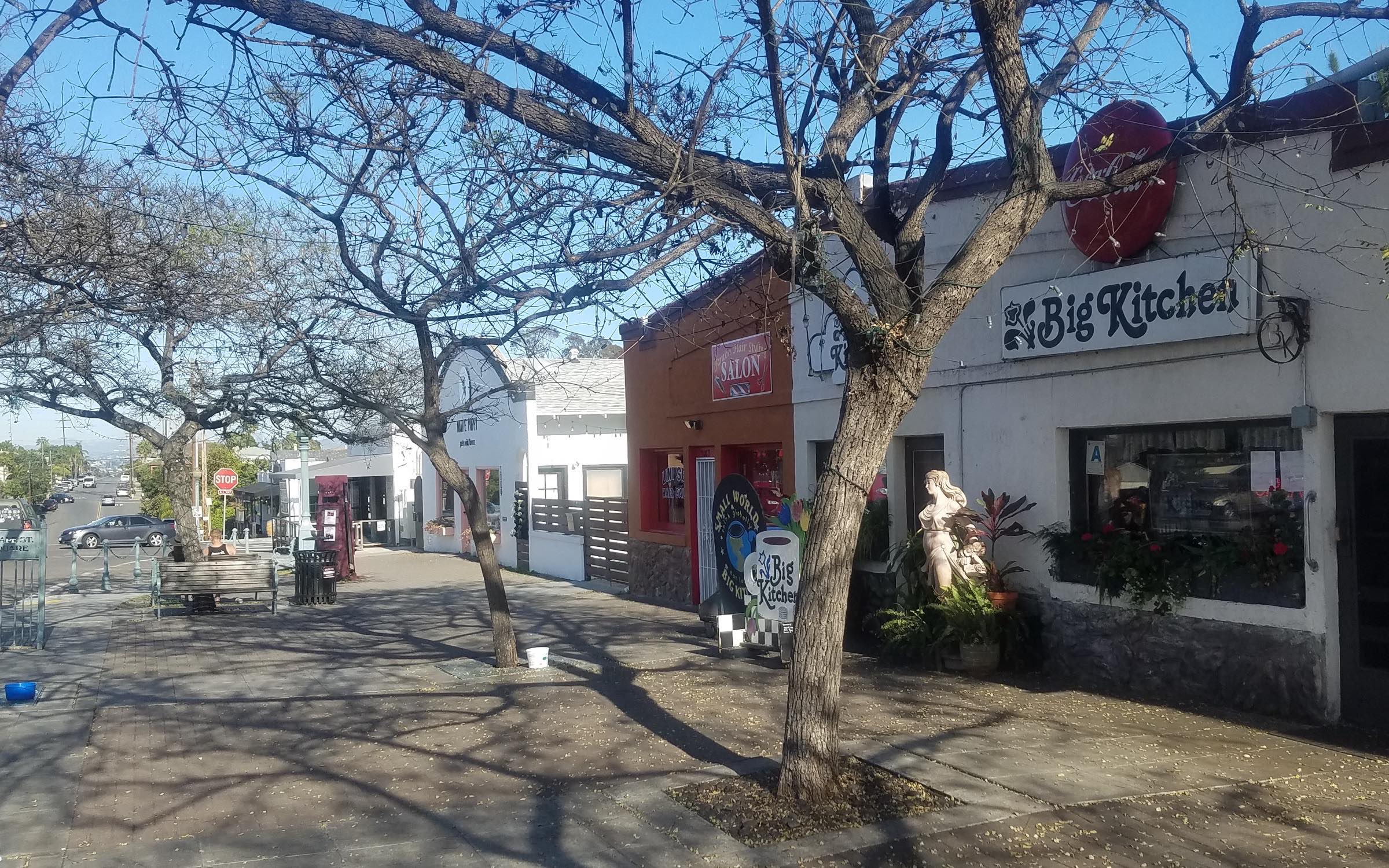
Photo: Coastside, Wikimedia Commons, CC BY-SA
South Park is the northeast corner of the Greater Golden Hill community, on the east side of Balboa Park. The City's community plan draws the line at A Street: Golden Hill to the south, South Park to the north, up to Juniper Street, where North Park begins.
In the early 1900s, E. Bartlett Webster's Bartlett Estate Company began subdividing lots along the east side of City Park — now Balboa Park — and called the area South Park. To sell lots, he built the South Park and East Side Railway, a streetcar line that ended at Cedar and 30th streets.
South Park straddles two zip codes — most homes are in 92102, and the blocks near Juniper Street are in 92104 — so zip-code stats miss it. We use the community plan boundary and place each sale by its map location. It is a small, house-heavy market: about 30 sales a year, almost all single-family homes.
Tell us what you're looking for and we'll send you every match, including homes that may never hit the open market. It takes about a minute.
Maeve is our AI assistant, not a person. A member of our team follows up on every request.
| 2026 so far | Sales | Median price | $ / sq ft | Days |
|---|---|---|---|---|
| Golden Hill | 38▼ 5 | $787,500▲ 32% | $673▼ 2% | 20+1 day |
Jan 1 – Nov 10, 2026. Small lines = change from the same dates in 2025.
| Closed sales, South Park | Sales | Median price | $ / sq ft | Days |
|---|---|---|---|---|
| All homes · 2026 | 22 | $1,332,500 | $1,025 | 14 |
| All homes · same dates 2025 | 29 | $1,325,000 | $980 | 12 |
| All homes · full-year 2025 | 30 | $1,342,500 | $976 | 12 |
| Golden Hill · 2026 | 38 | $787,500 | $673 | 20 |
| Golden Hill · same dates 2025 | 43 | $597,000 | $688 | 19 |
| Golden Hill · full-year 2025 | 47 | $600,000 | $689 | 19 |
With so few sales, medians can swing a lot from year to year. Every one of the 22 sales from January 1 to November 10, 2026 was a single-family home, as were 29 of the 30 in full-year 2025 (the other was a townhome), so the all-homes numbers above are effectively single-family numbers. Too few condos sell here to report. For comparison, Golden Hill, south of A Street, is mostly condos, so its median is much lower.
Source: San Diego MLS, closed residential sales, Jan 1 – Nov 10, 2026 vs. Jan 1 – Nov 10, 2025, and full-year 2025. Homes inside the Greater Golden Hill community plan area north of A Street (the South Park neighborhood as the plan describes it), placed by map location in the two areas on our map below — zips 92102 and 92104. Golden Hill rows cover the rest of the same plan area, south of A Street. Houses, condos and townhomes; manufactured homes, timeshares and two-to-four-unit income properties (a separate MLS category) are not included. "2026" is January 1 – November 10, 2026; "same dates 2025" is January 1 – November 10, 2025. Medians; "Days" is median days on market.
Based on all 52 sales here from January 1, 2025 through November 10, 2026. Every price range here is mostly houses. The difference is size: about 1,000 square feet under $1.2M, about 2,200 above $1.6M.
~$1.05M
Smaller houses: 16 of 17 were single-family homes, almost all east of 30th Street. One townhome was the only attached sale.
~$1.39M
The heart of the market: all 24 were single-family homes, typically 3 bed, 2 bath and about 1,300 square feet, with a median build year of 1925.
~$1.75M
Larger houses, typically 4 bed, 3 bath and about 2,200 square feet: 6 west of 30th Street and 5 east of it.
Source: San Diego MLS, closed residential sales, Jan 1, 2025 – Nov 10, 2026, placed by map location (South Park, Greater Golden Hill plan area north of A Street). Medians. East and west of 30th Street are the two areas on our small-markets map below.
South Park is small enough that we split it just once, at 30th Street, into the two areas on our map below. The historic district runs across that line, and Golden Hill, south of A Street, is described for comparison.
The blocks closest to Balboa Park, including much of the South Park Historic District. Fewer sales, larger homes: 8 sales in full-year 2025, at a median of $1.60M. Only 3 sold from January 1 to November 10, 2026 — too few to report a median.
Get West of 30th homes ›Most of South Park's sales, on blocks running toward the 32nd Street and 34th Street canyons. The community plan notes views from east of the 32nd Street canyon toward the bay and the mountains. Median sale price, January 1 – November 10, 2026: $1.29M (19 sales).
Get East of 30th homes ›A Local Register district on the City's map, covering the blocks from A Street up to about Elm Street between 28th and 31st streets. The City's map shows roughly 420 contributing properties. The historic rules in the questions below apply on every lot inside it.
The rest of the Greater Golden Hill community: older Victorian-era and early-1900s homes mixed with apartments and condos, and views of downtown and the bay west of 26th Street. It has its own Local Register historic district.
One median hides a lot. Here is how each part of South Park has actually sold, area by area. Tap an area on the map or read the list.
Too few 2026 sales to report.
2025: 8 sales, median $1.60M, $937 / sq ft
Get West of 30th homes ›2025: 22 sales, median $1.23M, $1,036 / sq ft
Get East of 30th homes ›Source: San Diego MLS, closed sales of houses, condos and townhomes. "Jan 1 – Nov 10, 2026" = Jan 1 – Nov 10, 2026; map shading uses Jan 2025 – Nov 2026. Medians. Typical range = the middle half of sales (25th to 75th percentile). "Days" = median days on market. Areas with fewer than 5 sales in a period show "too few sales to report." Area outlines are approximate; see below.
Tell us what you're looking for and we'll send you every match, including homes that may never hit the open market.
The park forms South Park's west edge. The plan describes the neighborhood as subdivided along the east side of what was then City Park.
The shops and restaurants along 30th Street near Juniper form South Park's business district. The North Park plan describes it as connecting with North Park's shops up 30th Street.
The South Park and East Side Railway ran to Cedar and 30th streets; John D. Spreckels later extended the line along 30th Street to North Park. A diagonal strip of open space at Ivy and Fern streets is the only visible remnant.
The community plan notes bay views from the blocks east of the 32nd Street canyon, along with the rolling hills of Encanto and the distant Laguna Mountains.
Every home sold in South Park from January 1, 2025 through November 10, 2026 was inside a transit priority area on the City's map, which means no required parking for a single-family home.
South Park is served by the San Diego Unified School District. School assignments vary by address, so confirm with the district.
General information, not legal advice. Rules change and depend on the parcel — we confirm details with the City and the right professionals on every deal.
The South Park Historic District (Local Register) covers the blocks from A Street to about Elm Street between 28th and 31st streets; the Golden Hill Historic District is just south of A Street. On a single-family lot in a designated historic district, new development needs a Site Development Permit, decided through the City's Process Four, unless it qualifies for an exemption. Exempt work still needs a regular construction permit.
Exemptions include minor alterations, and new construction that keeps the district's character, when the work follows the Secretary of the Interior's Standards; and larger changes to a structure that is not significant to the district, also following those Standards. The rules apply to the whole lot, not just the house. The public map shows each district's outline, not whether a given home is a contributing resource — ask the City early.
Source: San Diego Municipal Code §143.0210(a), (b) and (e)(2)(A); §143.0220(a) and (c); §143.0251. District list: City of San Diego Historic Districts map (Planning Department GIS), checked November 13, 2026.Yes. Most houses here are old enough to trigger it: 31 of the 51 single-family homes sold in South Park from January 1, 2025 through November 10, 2026 were built before 1940. For a permit on any parcel with a structure 45 or more years old (outside areas the City has exempted), the City decides whether a site-specific historic survey is needed — within 10 business days for a construction permit, or 30 calendar days for a development permit. A survey is required when a historical resource may exist and the project is a substantial alteration. Interior-only electrical or plumbing work, in-kind roof repair, in-kind foundation repair (except decorative block or cobblestone foundations) and a rear-yard pool are exempt from this review.
Separately, the City's Historical Resources Board can designate individual homes after a public hearing; owners get notice at least 10 business days before. The City's map shows roughly 60 individually designated historical resources in South Park.
Source: San Diego Municipal Code §143.0212(a) and (c); §123.0202(a), (b) and (e). Year built: San Diego MLS. Designated resources: City of San Diego Historical Resources map (map points), November 2026.The Mills Act lets the owner of a City-designated historic property sign a contract with the City to maintain and restore it, in exchange for a property tax assessment set by the County Assessor under a state formula. The City says savings depend on the property's location, size and comparable rents, and that long-held homes with already-low taxes may not benefit.
The home must be designated by the City — listing on the National or California Register alone does not qualify — and the City says homes in established local historical districts can apply, except in redevelopment areas. Applications are due March 31; the home must have been designated by December 31 of the year before; and the application needs a 10-year work plan showing the tax savings going back into the house. The contract runs 10 years and renews every year.
Source: City of San Diego Council Policy 700-46 (Mills Act Agreements), Background and Implementation 1(B)–(C); City of San Diego Development Services, “Mills Act Property Tax Reduction” page (checked November 13, 2026); California Government Code §50280 and following.Usually, yes. On a lot with a single-family home, the City allows one ADU inside the house or an existing accessory structure such as a garage, plus one new attached or detached ADU, plus one junior ADU of up to 500 square feet inside the house or an attached garage. A new attached or detached ADU can be 150 to 1,200 square feet. ADU floor area counts toward the lot's floor-area limit, but one ADU of 800 square feet or less is allowed even where floor-area, lot-coverage or front-setback limits would block it.
Detached ADUs on single-family lots can be up to two stories, within the zone's height limit. Side and rear setbacks for an ADU 16 feet tall or less are zero outside High and Very High Fire Hazard Severity Zones, and 4 feet inside them. No parking is required for an ADU here, and a garage converted to an ADU does not have to be replaced. ADUs cannot be rented for less than 31 days; owners don't have to live on site, except with a junior ADU. South Park is outside the Coastal Overlay Zone, so the City's current ADU rules apply. On a lot in the historic district, the historic review rules above still apply to new construction.
Source: San Diego Municipal Code §141.0302(a)(8), (b)(1), (b)(4), (b)(7), (b)(8), (b)(9)(C), (b)(10), (b)(11), (c)(1) and (c)(4); §143.0210(a). Coastal Overlay and beach parking overlay: City of San Diego zoning overlay map.It lets an owner build extra “bonus” ADUs in exchange for affordable ADUs rented to very low, low or moderate income households. Inside a Sustainable Development Area (near major transit), each affordable ADU earns one bonus ADU; outside one, the cap is one bonus plus one affordable ADU. On a single-family lot, all ADUs and junior ADUs together are capped by lot size: 4 on lots of 8,000 square feet or less, 5 up to 10,000, and 6 above that. Floor area is figured on no more than 8,000 square feet of lot.
Affordability is set by an agreement with the San Diego Housing Commission — 10 years for very low or low income, 15 years for moderate — with a penalty of at least $10,000 per ADU per month for violations. Bonus and affordable ADUs need fire sprinklers, and one parking space each outside a transit priority area. The program isn't available in the RS-1-1 to RS-1-4 and RS-1-8 to RS-1-11 zones unless the lot is in a High or Highest state opportunity area and planned Residential. In High and Very High Fire Hazard Severity Zones, the lot must front an improved public street with two evacuation routes and cannot be on a cul-de-sac. Canyon-edge lots may be in a Very High Fire Hazard Severity Zone on the City's map — most South Park sales from January 1, 2025 through November 10, 2026 were.
Source: San Diego Municipal Code §141.0302(d)(1)–(8) and Table 141-03A. Fire hazard zones: City of San Diego fire hazard severity zone map (Fire-Rescue GIS).A transit priority area is land within half a mile of an existing or planned major transit stop. On a lot even partly inside one, the City requires no off-street parking for a single-family home. On the City's map, all 52 homes sold in South Park from January 1, 2025 through November 10, 2026 were inside a transit priority area.
SB 9 duplexes and lot splits are not available on a lot in a designated historic district or with a designated historical resource. That rules out SB 9 on every lot inside the South Park Historic District. The City's Complete Communities Housing Solutions program — extra floor area for apartment and mixed-use projects that include affordable homes and neighborhood amenities — applies only in Sustainable Development Areas on sites zoned or planned for at least 20 homes per acre, so it matters for corridor and apartment sites, not single-family lots. It does not apply inside designated historic districts here.
Source: San Diego Municipal Code §113.0103 (definition of transit priority area); §142.0520 and Table 142-05B; §143.1303(b)(1)(J); §143.1002(a) and (b)(6). Transit priority area share: City of San Diego Transit Priority Area map (Planning GIS), applied to MLS sale locations.Enter an address and see the zoning, setbacks, height and floor-area limits that apply — with the city code cited for every rule.
Whether you are buying, selling or planning a remodel, our team can walk you through the block-by-block numbers and the historic rules. We respond within 24 hours.

