




For years, one of the first questions my clients asked me was a simple one: what can we actually do with this property? Can we add a second story? Is there room for a guest house? Could the lot be split someday?
The answer was never simple. Getting it took weeks. We'd make trips to the city, often more than one, to pull zoning and ask questions at the counter. Our title rep would work with the city on our behalf to track down records. Then we'd piece it all together by hand, read through the code and make sure nothing was missed. It was good, careful work, but it was slow, and in this market slow can cost you.
So, as a NEW FEATURE on our website, we built a better first step.
Meet Feasibility Check
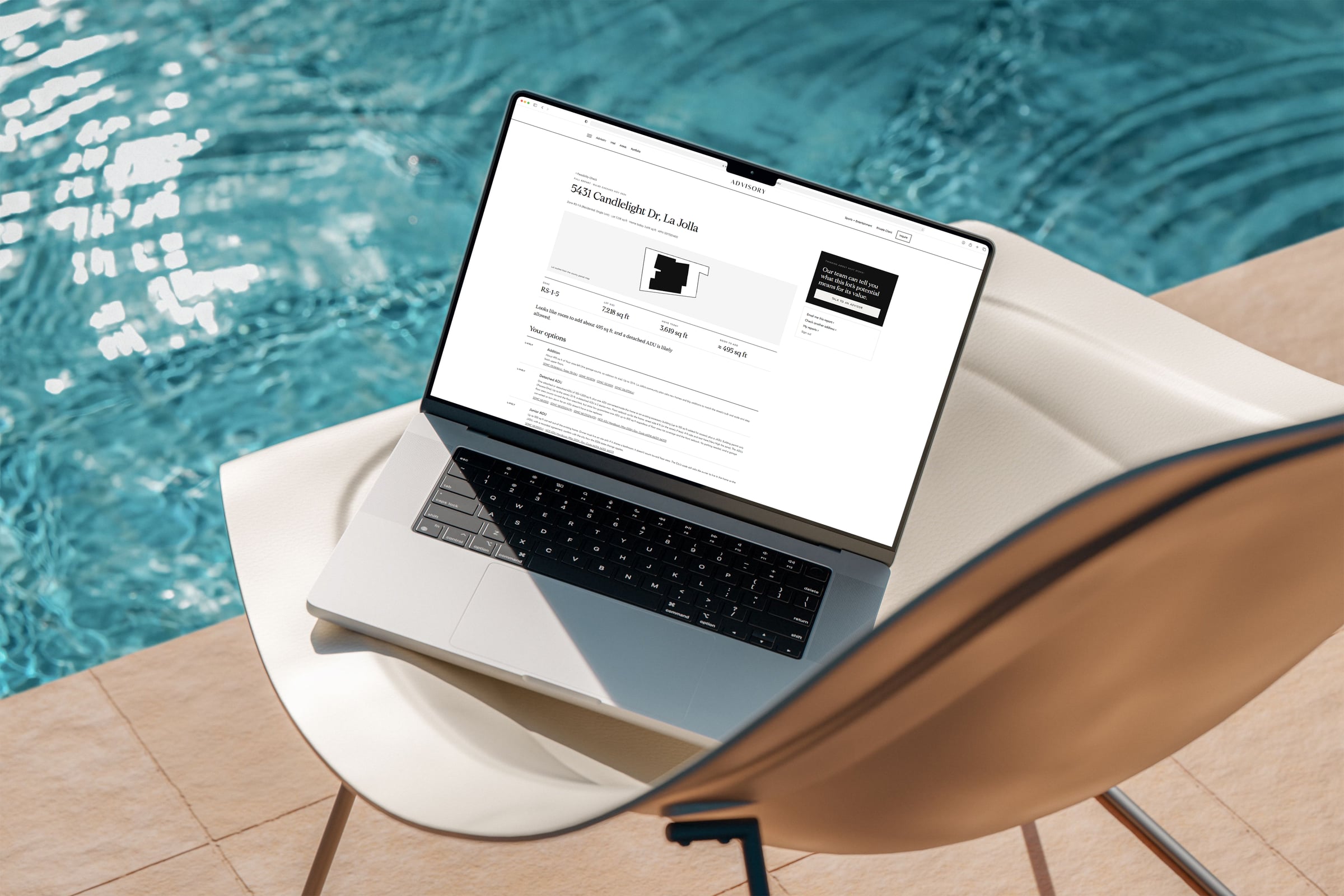
Feasibility Check is a new proprietary tool on our website. You enter an address, and it finds the lot, its zone and its size from public city and county maps. It then condenses that public data into one profile for the property, showing what it could theoretically build or remodel under city code.
Here's what each profile covers:
Room to add: the most house the lot allows, and how much is left over.
Height and setbacks: how tall and how close to the lot lines you can build.
ADU and JADU: guest house and in-home unit options under state law.
Lot split: whether SB 9 could let you split the lot or add a second home.
Yard: fences, decks, pools, pergolas and grading.
Every rule links to the city code it comes from, so you can see exactly where each answer starts.
Today it covers Solana Beach, Del Mar, Encinitas, Cardiff, Leucadia, Olivenhain, Rancho Santa Fe, Carlsbad, La Jolla, Point Loma, Mission Hills, North Park, South Park, Pacific Beach, Carmel Valley and Coronado. If your property is somewhere else, enter it anyway and our team will look into it.
How this helps our clients
For buyers, it means knowing early whether the plans you have in mind are realistic, before you fall in love with a house or write an offer. You walk into conversations with your architect or contractor already knowing the basics.
For sellers, it means understanding your lot's potential and being able to show it. A buyer looking at two similar homes will notice which one has room to grow.
For both, it means our team spends less time gathering facts and more time advising you on what they mean.
What it isn't
I want to be clear about this part. Feasibility Check is a starting point, not the final word. It's a planning estimate built from public map data and city codes. Buyers and sellers still need to verify everything with the city, their architect and any other regulations that apply to the property before making plans. What it does is take the initial fact finding that used to take weeks and put it in one place, so those next conversations start from a much stronger spot.
Try it
You can try it now on our Feasibility Check page - https://advisorysandiego.com/feasibility. Enter an address for a free preview with the zone, lot size, room to add and a quick answer. Fill in your contact information to create a free account, and you'll get the full report with every rule and its source, watch-outs, answers to common questions and a copy by email.
And if you'd like to talk through what your results mean, reach out. That's the part we love most.

Long-Term Homeownership Trends Continue to Demonstrate Real Estate's Enduring Stability
New data from Redfin shows the typical homeowner holds property for 8.4 to 12 years before selling — a pattern that tells a deeper story about how wealth is actually built through real estate.
Redfin data shows the typical homeowner holds property for 8.4 to 12 years before selling, with 81% reporting no plans to sell within three years. Here's what that means for buyers and owners in coastal San Diego.
Read the story ›

Stay informed.
The weekly market update and new listing alerts, delivered to your inbox.