




A few days ago I sat in on an AI session, and I left with my jaw somewhere near the floor. The hosts walked through how they use Grok Bot. Real estate agents already have bots that sign into their accounts, fill out forms, draft emails and tackle tasks before anyone asks. Picture a tireless assistant who never needs coffee.
It was exciting. It gave me an idea for a gap in my own business. It also made me want to pump the brakes for a minute.
A headline is not a strategy
There's a new AI headline every week, and everyone at the open house has a sound bite about what's working for them. It's easy to hear one great story and sign up by lunch.
But a sound bite tells you what worked for someone else. It doesn't tell you what fits the way you run your business. Buying an AI agent off one demo is like writing an offer on a house from the listing photos. Tempting, yes. Wise, not so much.
So I did the showings myself
Over the last few weeks I researched and tested four of these tools side by side: Grok Bot, Muse, Dots and Claude Duet. I wasn't hunting for the best tool on earth. I was hunting for the right one for me.
Spoiler: they're all impressive. All four are what people call always-on agents. They keep working after you close the app, and they can take action in the tools you connect, not just chat.
Here's my honest walkthrough: the curb appeal, and what I'd flag on inspection. These products are weeks or months old and change constantly. Prices below are as of mid-November 2026, so check before you sign up.
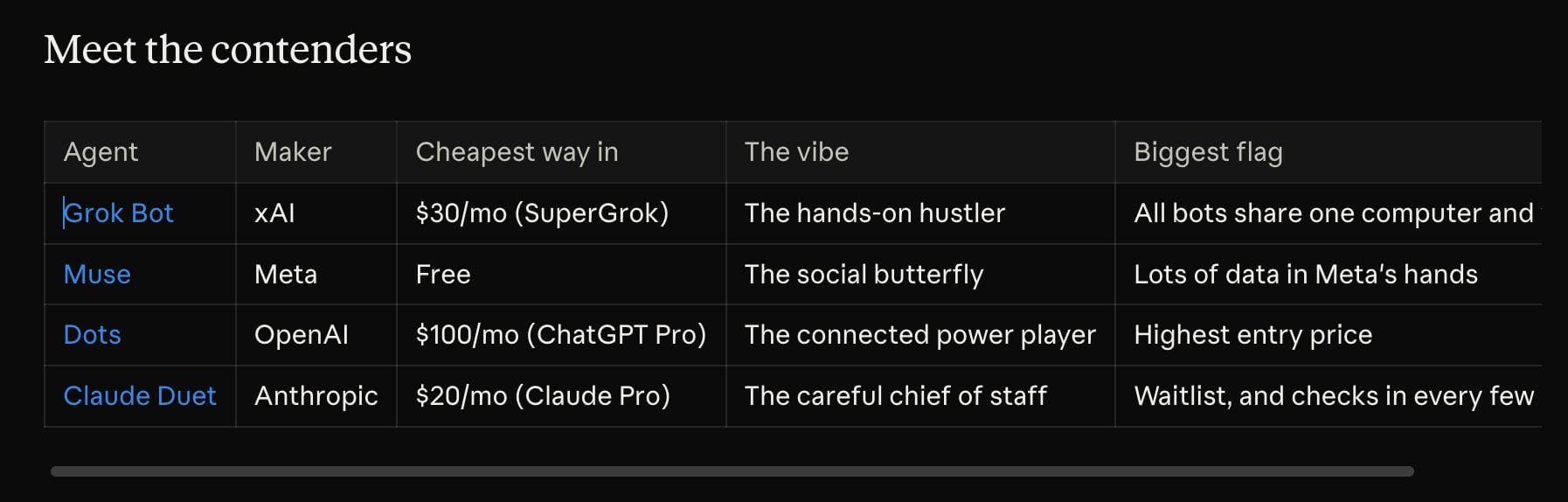
Meet the contenders
Grok Bot (xAI): the hands-on hustler
Grok Bot is the one from the demo that started all this. It's also the most mature of the bunch: it launched in beta on August 11 and hit version 1.0 on November 2.
The curb appeal
Your bots get a cloud computer with a browser, terminal and files. They sign into the tools you already use, including portals with no official integration.
You can run a whole roster of named bots, each with its own job, and set up recurring routines.
It keeps working with your laptop closed, and it pauses for your approval on consequential actions.
The inspection report
All of your bots share one cloud computer and the same logins. One bot's access is effectively every bot's access.
There's no standalone price. You get it through an xAI plan ($30, $100 or $300 a month) or a Cursor plan, and access rules have shifted several times since August.
Heavy use is metered past a weekly allowance. In my testing, the tokens went fast.
My take: for what it costs, I wanted more visual feedback and tighter guardrails than it offers today.
Muse (Meta): the social butterfly
If your business lives in the Instagram grid and the Facebook feed, Muse speaks your language. It launched September 8.
The curb appeal
The easiest door to walk through: a free tier (about 100 million tokens a week), then $20 and $100 plans.
Facebook, Instagram and Meta ads are core, plus Shopify and Stripe. It also runs on iOS, Android, the web and WhatsApp.
It works in its own cloud computer with a browser you can watch. It asks before purchases and other sensitive actions.
In my experience, you get a lot for what you pay. It's great for lighter business tasks and everyday life admin.
The inspection report
It's brand new, and some sites are already pushing back. Amazon blocked Muse from shopping on its site.
Meta doesn't review the custom connectors you add.
Outlets like Implicator.ai have reported internal security flaws. Independent audits are still to come.
My take: I genuinely question what it's doing with all that data.

Dots (OpenAI): the connected power player
Dots launched at OpenAI's DevDay on September 29 and lives inside ChatGPT, which many agents already have open all day.
The curb appeal
The Rolodex is huge: more than 4,000 app integrations.
You can reach your dots in ChatGPT, Slack, Microsoft Teams or by phone call, and they can deliver briefings.
Each dot has its own cloud computer and browser, learns your preferences, and can work alongside others in a shared ChatGPT Space.
In my experience, ChatGPT has the most natural voice conversations of the bunch.
The inspection report
It has the highest cover charge. Dots aren't on Free, Go or Plus. ChatGPT Pro starts at $100 a month, and Business Premium seats run $100 to $125 per user.
OpenAI hasn't published prices for extra dots or more horsepower.
On launch day, OpenAI also cut the usage on its $200 Pro plan in half. Plans move fast here.
Claude Duet (Anthropic): the careful chief of staff
Duet opened as a research preview on October 21. It's built to work like a chief of staff: it brings you what needs your attention instead of waiting to be asked.
The curb appeal
It starts your day with a morning brief and flags what needs you.
It checks with you before acting on your behalf, like sending a message.
It connects to Gmail, Canva, QuickBooks, Shopify, Slack and many more, and it hands back real deliverables: research briefs, financial models, slide decks, dashboards.
It has receipts on security. Red teams and an outside firm penetration tested it, and it's in Anthropic's public bug bounty program.
It's included at no extra cost during the preview for Claude Pro ($20 a month) and Max subscribers.
The inspection report
There's a velvet rope: a waitlist, US only, Pro and Max only. Team and Enterprise plans aren't supported yet.
It checks your connected accounts every few hours, not continuously. It's the least "always-on" of the four.
Anthropic itself says it can misjudge what's urgent and is weaker at personal errands than at work tasks.
Its background work draws from the same usage limits as your regular Claude chats.
Before you write the offer
Answer these honestly first:
Where does your business actually live? Instagram and Facebook point to Muse. ChatGPT and Microsoft Teams point to Dots. Google Workspace and tools you've built yourself point to Duet. A roster of bots working inside web portals points to Grok Bot.
Do you want a drafter or a doer? The more it acts on its own, the more the guardrails matter.
What are you handing over the keys to? Think through what happens if that account is ever compromised.
What's your real budget? Free, $20 and $100-plus a month are very different commitments, and usage limits matter as much as the sticker price.
What does your brokerage allow? Check its AI policy before you connect client files. You're still on the hook for compliance, whatever the bot does.
Solo or team? Team plans and shared bots vary a lot from one system to the next.
Which agent fits which agent
The social-first agent who lives on Instagram and Facebook: Muse is worth a look, and the free tier makes it a no-risk test drive.
The ChatGPT power user or the Teams-based office: Dots slots right into what you have, if the budget works.
The tinkerer who wants a crew of bots working inside web portals: Grok Bot is the most hands-on, with the most security to manage.
The agent who wants a careful chief of staff for briefs, drafts and reminders, with approval before anything goes out: Duet.
Why my answer may not be yours
I've built my own systems with Claude Code: my team dashboard, my home life dashboard, my website and my content studio. So much of my business already runs on Claude that Duet was the natural fit for me.
For another agent with a different setup, the right answer could easily be one of the others. That's the whole point.
The big lesson from the compass retreat
This was the real takeaway from our New Orleans retreat. People are doing amazing things with AI right now, and that's exactly why it pays to pause before you jump in.
Talk to more than one person. Ask agents who use each tool what it does for them day to day, and ask to see their workflow.
Test it on your real work. One real week of your business beats any demo.
Look at what you already use. The best tool fits the habits you have.
Give it a few days. Nobody's going to outbid you on this one.
My line in the sand: money stays off-limits
Everyone gets to make their own call here. For me, after a lot of research and conversations with some very savvy people in AI, connecting my bank or investment accounts to an AI bot is a hard no. There have been too many recent hacks and vulnerabilities.
Whatever you decide, know your security settings cold. Understand exactly what you're giving your AI access to, and what it would mean if it were ever hacked. I'll go deeper on AI and security in an upcoming post.
The takeaway
Don't buy on the headline, and don't buy on someone else's sound bite. Do your showings, read the inspection report, and talk to enough people that you feel confident in your choice.
The right system is the one that fits how you work.

Cardiff in October 2026
Few sales, firm pricing, and a thin supply of homes. Here is what the numbers say, single-family and condo alike.
Cardiff (92007) October 2026: detached year-to-date median sales price of $2,872,500, up 26.3%, with 6 single-family homes for sale. Full analysis from Advisory San Diego.
Read the story ›


Stay informed.
The weekly market update and new listing alerts, delivered to your inbox.